
Flat Back Earrings for Lobes That Feel Better
A lobe piercing might be the most familiar piercing you own, but it still deserves jewellery that does not catch in your hair, press into your neck while you sleep or feel awkward beneath headphones. Flat back earrings for lobes offer a polished answer: a smooth disc sits behind the ear instead of a traditional butterfly fastening, making everyday wear feel noticeably more comfortable.
For a first lobe piercing, a carefully built stack or a single subtle sparkle, the right flat back can make the difference between jewellery you admire in the mirror and jewellery you genuinely forget you are wearing. The details matter, though. Post length, gauge, fastening and metal all affect how a piece sits and feels.
Why flat backs work so well in lobe piercings
A flat back earring is usually made from a labret-style post. The decorative front - perhaps a crystal, tiny star, polished ball, heart or gemstone - attaches to a post with a smooth, flat disc at the rear. That disc is designed to rest comfortably against the back of the lobe.
Traditional butterfly backs have their place, especially for occasional wear. Yet they can snag on towels, collect product build-up and create a point of pressure when you sleep on your side. A properly fitted flat back has a lower-profile finish. It is particularly useful for second, third and high-lobe placements, where several conventional backs can quickly feel crowded.
There is also a style benefit. Flat back jewellery gives the front design more of the attention. That makes it ideal for a curated ear look, whether you prefer delicate gold tones, bright stones, Gothic details or a mix of tiny charms across the lobe.
Choosing the right flat back earrings for lobes
The prettiest design will not feel right if the fit is wrong. Lobe thickness varies more than people expect, and a post that works beautifully in one placement may be too tight or too long in another.
Start with post length
Post length is the measurement that most affects comfort. If a post is too short, the jewellery can pinch, leave an impression in the skin or feel tight when your lobe naturally swells. If it is too long, it may move around, catch more easily and leave excess bar visible at the front or back.
A healed lobe often suits a shorter post for a neat, close fit. Fresh piercings generally need additional room to allow for swelling, and should be assessed by a professional piercer rather than fitted by guesswork. Even a healed piercing can need a slightly longer post if your lobe is fuller, the placement is higher up, or you prefer a less fitted look.
If you are replacing existing jewellery, take note of the length and gauge you currently wear before ordering. If it has never felt quite right, that is useful information too. A professional can measure the piercing and recommend a size that gives your lobe breathing room without unnecessary movement.
Check the gauge before you buy
Gauge refers to the thickness of the post. Many standard lobe piercings are fitted with a finer gauge than cartilage piercings, but there is no one-size-fits-all rule. Forcing a thicker post through a smaller healed channel can be uncomfortable and may irritate it.
It is tempting to assume every earring is interchangeable because the front design looks similar. It is not always the case. Treat gauge as part of the fit, not a technical detail to skip.
Decide on the fastening style
Flat backs are commonly available in internally threaded and threadless styles. With internally threaded jewellery, the front screws into the post. This means the thread is not travelling through the piercing, which is generally kinder to the channel than externally threaded alternatives.
Threadless jewellery uses a slightly bent pin that pushes into the post, creating tension to hold the decorative end in place. It is sleek, practical and excellent if you like changing the front design while keeping a well-fitted post in your piercing.
Neither choice is automatically better for everyone. A screw-fit front can feel reassuring if you are worried about security, while threadless styles make building a versatile jewellery wardrobe especially easy. Whichever you choose, take your time when fitting it. Small ends are easy to drop, and overtightening a threaded piece can make the next change unnecessarily fiddly.
Metal is not just about the finish
Gold-tone jewellery may be your signature, while silver gives a crisp, understated look. But beneath the colour, material quality matters. Lobe piercings are often forgiving once well healed, yet low-quality fashion metals can still lead to itching, discolouration or a greenish mark where metal meets skin.
Sterling silver and 18k gold designs bring a more elevated finish to a healed lobe stack. They are ideal choices when you want jewellery that looks considered rather than disposable. Just be aware that sterling silver can tarnish naturally over time, especially if it meets perfume, hairspray or moisture. A gentle polish with an appropriate jewellery cloth restores its shine.
For a fresh piercing or a piercing that is still unsettled, speak to your piercer about suitable body-safe materials. Healing jewellery is a different category from a fashion-led piece chosen for a fully healed piercing. The aim is not to compromise your healing process for a particular look - there will be plenty of time for the fun part once the piercing is ready.
Styling a lobe stack without making it busy
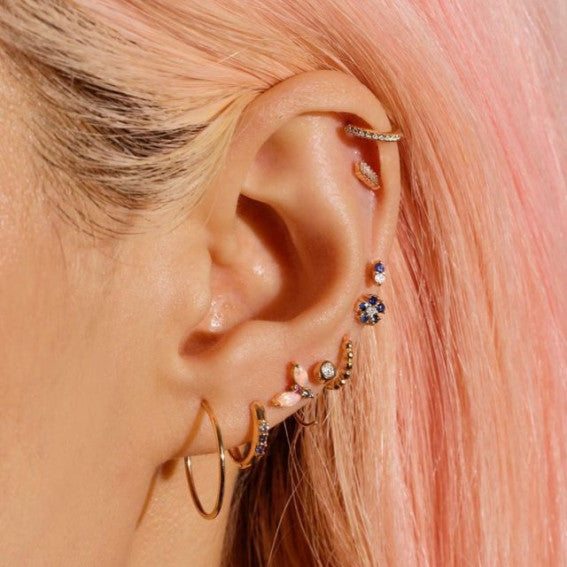
Flat backs make layered lobe styling much easier because the backs sit smoothly against the ear. You can wear multiple pieces without the familiar tangle of butterfly fastenings, which is useful if you have a first, second and third lobe piercing or a high-lobe placement leading towards the helix.
Start with one focal point. A small hoop or statement stud in the first lobe gives the ear a visual anchor. Then add smaller flat back studs above it: a clear stone, petite moon, polished bead or subtle coloured gem. Keeping the upper placements smaller lets the layout feel intentional rather than crowded.
Matching every piece is not essential. In fact, a mix often looks more personal. Pair a warm 18k gold finish with a tiny crystal, or balance a bolder Gothic front with two simple metallic studs. The thread that ties a stack together might be a single metal tone, a recurring stone colour or simply the same scale of jewellery.
For gifting, a pair of classic flat back studs is a thoughtful choice when you know the recipient has healed lobe piercings and wears labret-style jewellery. If you do not know their post length or gauge, a decorative front rather than a complete fitted piece can be a safer option - provided their existing post uses a compatible fastening system.
Everyday care that keeps jewellery comfortable
Even the best-fit flat back needs occasional attention. Wash your hands before touching your jewellery, especially when changing an end or checking a fastening. Remove styling products from around the ear after getting ready, and dry the area carefully after a shower or swim.
For healed piercings, clean the jewellery as needed with a method suitable for its material. Avoid harsh household cleaners, toothpaste and random social-media remedies. They can dull finishes, damage stones or irritate the skin. If a fastening starts to feel stuck, do not force it. A piercer can help remove or refit it without turning a quick jewellery change into a sore lobe.
A little movement is not always a problem, but persistent redness, pain, heat, swelling or discharge deserves proper advice. Remove the temptation to keep swapping jewellery in the hope that it settles. Getting the post length and material assessed is usually the smarter move.
When a flat back may not be the best choice
Flat backs are brilliant for daily comfort, but they are not the only right answer. If you regularly change earrings to match outfits and prefer a quick, familiar fastening, classic studs may suit your routine better. Some people also find tiny screw-on ends difficult to handle without help, particularly if they have long nails or limited dexterity.
There is a solution for most of these concerns. Threadless designs can be easier to change once you know the technique, and a piercer can fit a quality post then help you choose ends to rotate through. The key is selecting jewellery around your lifestyle, not just the photograph.
London Loves Body Jewellery curates pieces with this real-life wearability in mind: premium materials, expressive fronts and piercing-aware fits that let your style stay comfortable from morning to night.
Your lobes are a small canvas, but the jewellery you wear there is often the first detail people notice. Choose a flat back that fits your piercing properly, feels good when your head hits the pillow and makes every part of your ear stack feel distinctly yours.