
Labret Piercing Jewellery Guide for Every Fit
A flat-back stud can make a curated ear feel polished rather than crowded - but only when it sits comfortably and suits the piercing. This labret piercing jewellery guide cuts through the confusing measurements, metal choices and style options, so you can shop with confidence rather than hoping a pretty piece will fit.
Labrets are among the most versatile pieces in body jewellery. Despite the name, they are not only for lip piercings. Their smooth, flat disc sits neatly against the skin, making them a favourite for helix, tragus, conch, forward helix, lobe and some nose piercings. The decorative end faces outward, while the backing stays discreet and comfortable.
What is labret piercing jewellery?
A labret is a straight post with a flat disc at one end and a removable decorative top at the other. Unlike a butterfly-backed earring, there is no protruding clasp pressing into the back of your ear or catching in your hair. That simple difference is why labrets are such a strong choice for everyday wear, sleeping and building a layered ear look.
The term can describe the style of post as well as jewellery worn in a traditional lower-lip labret piercing. When shopping, focus on the placement you are buying for, not just the product name. A labret made for a healed tragus may have a very different length from one suited to a conch or lip piercing.
Labret piercing jewellery guide: get the fit right
The most beautiful gold star, crystal or gothic motif will not feel right if the post is too short, too long or the wrong gauge. Fit is not an afterthought - it is what makes premium jewellery comfortable enough to wear on repeat.
Gauge is the thickness of the post
Gauge refers to the thickness of the bar. In UK body jewellery, this is usually shown in millimetres. Many ear cartilage and lip piercings use 1.2 mm, also known as 16 gauge, while certain lobe and nostril placements may use 1.0 mm, or 18 gauge.
Do not assume every piercing uses the same thickness. Forcing a thicker post into a healed piercing can cause irritation, while a noticeably thinner one may not sit as securely as intended. If you are replacing jewellery fitted by your piercer, check the gauge on your paperwork or ask them to confirm it before ordering.
Length is the wearable space
The length of a labret is measured from the underside of the decorative end to the flat disc, not including the top itself. This is the space that passes through your piercing.
For healed ear piercings, shorter lengths often give the neat, fitted finish people want from a curated stack. A post that is too long can move around, catch on hair and make a delicate design look untidy. Too short, however, can create pressure and leave no room for normal changes in the tissue.
There is no universal best length. Anatomy, placement and the angle of the piercing all matter. Fresh piercings need extra space for swelling, while a settled piercing may be downsized later by a professional. If your current jewellery feels comfortable, measuring it is a useful starting point. When in doubt, choose professional advice over guessing from a photograph.
The disc should sit flat, not dig in
The flat back is designed to rest against the skin with minimal fuss. It should feel smooth rather than tight, and it should not leave a deep indentation or become buried. In areas such as the tragus or forward helix, the comfort of the disc is often as noticeable as the front design.
A larger disc may offer more stability in some placements, but it can be more visible. A smaller disc looks discreet and is ideal when you want the decorative end to do the talking. This is one of those details that depends on the individual piercing and your preferred finish.
Choose a metal that suits your piercing and your lifestyle
Material affects comfort, durability and how your jewellery looks after weeks of wear. It also matters whether your piercing is fully healed.
For a new or irritated piercing, follow your piercer’s material recommendation. Implant-grade titanium is commonly chosen for initial jewellery because it is lightweight and widely suitable for sensitive skin. Do not switch a healing piercing simply to match an outfit, however tempting the new piece may be.
Once your piercing is well healed, premium precious-metal pieces bring more character to your collection. Sterling silver offers a bright, cool finish that works beautifully with polished, celestial and alternative looks. It needs sensible care, though: silver can tarnish over time and is generally better reserved for healed piercings rather than initial jewellery.
18k gold gives a richer tone and makes even a small labret feel special. Check whether a piece is solid gold, gold vermeil or plated, as these are not interchangeable. Solid gold is built for long-term wear, while plated finishes need gentler handling to protect the surface. If you have known metal sensitivities, read the full material details and keep your choice simple rather than relying on vague claims such as ‘hypoallergenic’.
Threading matters more than it seems
Labrets usually use either internally threaded or threadless fittings. Both can be excellent choices when made well, but they work differently.
With internally threaded jewellery, the threaded section is on the removable top, so the main post remains smooth as it passes through the piercing. This is a refined option for healed piercings and makes changing jewellery feel less harsh on the channel.
Threadless jewellery uses a small pin that bends slightly inside the post to create tension. It is neat, practical and particularly useful if you enjoy swapping tops to change your look. A properly fitted threadless top should feel secure, but it should not require force. If it loosens repeatedly, have the fit checked rather than bending it endlessly at home.
Externally threaded jewellery has its thread on the post itself. While it is common in lower-cost ranges, it is less ideal for inserting through a piercing because the threaded section can feel rougher. For jewellery you plan to wear often, smooth insertion and secure construction are worth prioritising.
Build your look around the placement
Labrets are the quiet workhorses of ear styling. Their flat backs allow the front detail to shine, whether you are creating a minimal gold edit or mixing stones, charms and themed motifs.
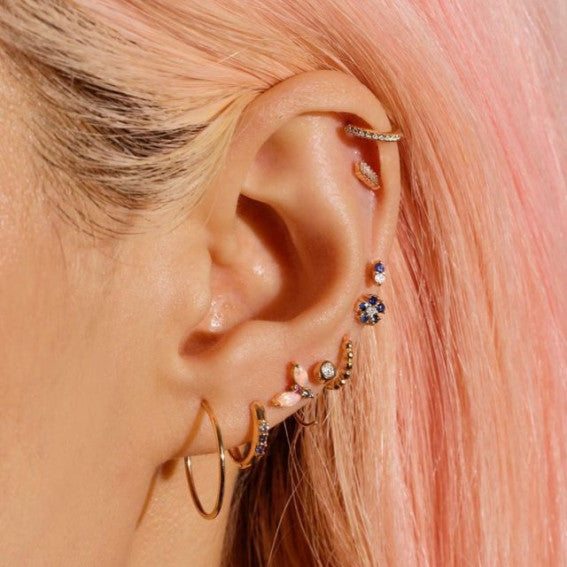
For a lobe stack, a tiny crystal, bead or polished ball can balance more statement-led hoops. In a helix, a slim marquise cluster or small moon design creates detail without overwhelming the outer ear. Tragus jewellery usually looks best with a low-profile top that does not compete with headphones, while a conch can carry a slightly bolder flower, opal or star.
Think about scale as well as style. A large decorative top may look striking in product imagery but can crowd a petite tragus or forward helix. Conversely, a very small piece can disappear in a conch. Matching metal tones creates an intentional, elevated finish, but mixing silver and gold can look equally considered when there is a repeating detail, such as clear stones or similar shapes.
London Loves Body Jewellery curates pieces with real piercing placements in mind, so it is easier to find designs that feel fashion-led without losing sight of fit and wearability.
When should you change a labret?
A healed piercing can still become unhappy if jewellery is changed too often, inserted roughly or fitted too tightly. Wait until your piercer confirms that the piercing is ready before replacing initial jewellery. Healing timelines vary widely: cartilage generally takes much longer than a standard lobe, and a lip piercing has its own aftercare needs.
When it is time to change, wash your hands, clean the jewellery as directed and work gently in good light. Never force a post through resistance. Swelling, heat, increasing redness, discharge or persistent soreness are reasons to pause the change and speak to a qualified piercer or healthcare professional where appropriate.
For day-to-day care, keep products such as hairspray, perfume and moisturiser away from the piercing where possible, then wipe your jewellery gently after wear. Store precious-metal pieces separately to reduce scratches and tarnishing. Small habits keep a favourite piece looking considered, not tired.
The right labret should feel almost unnoticeable while adding exactly the detail you wanted. Start with the correct gauge and wearable length, choose a material that respects your piercing’s stage, then let the design reflect your style - from understated gold to something a little more gothic, sparkly or playful.