
Labret Studs Versus Barbells: Which Fits Best?
A small change in jewellery shape can completely alter how a piercing feels, sits and photographs. When choosing between labret studs versus barbells, the best option is not simply the one you like the look of. It comes down to the piercing placement, your anatomy, how healed it is and whether you want a discreet everyday finish or a more classic, visible bar.
For curated ears, lip piercings and cartilage placements, getting that choice right makes jewellery feel like part of your style rather than something you are constantly aware of. Here is what experienced piercers consider before reaching for either piece.
Labret studs versus barbells: the key difference
A labret stud is a straight post with a smooth, flat disc on one end and a removable top on the other. That top might be a tiny ball, crystal, opal, gemstone cluster, charm or decorative motif. The flat back sits close to the skin, which is why labrets are such a popular choice for ears and lips.
A straight barbell also has a straight post, but it usually has a removable ball or decorative end at both sides. It is more symmetrical and more visible from every angle. You will often see straight barbells in tongue and nipple piercings, although they can suit selected ear placements too.
The distinction sounds simple, but the back of the jewellery makes a real difference. A flat-back labret is designed to minimise bulk where the jewellery rests against your skin. A barbell gives you two featured ends, but those rounded ends need enough space to sit comfortably.
Where labret studs work best
Labret studs are among the most versatile pieces in body jewellery. Despite the name, they are not only for lip piercings. Their neat flat-back construction makes them particularly useful where a standard butterfly-back earring would feel awkward or catch on hair, clothing and headphones.
Curated ears and cartilage
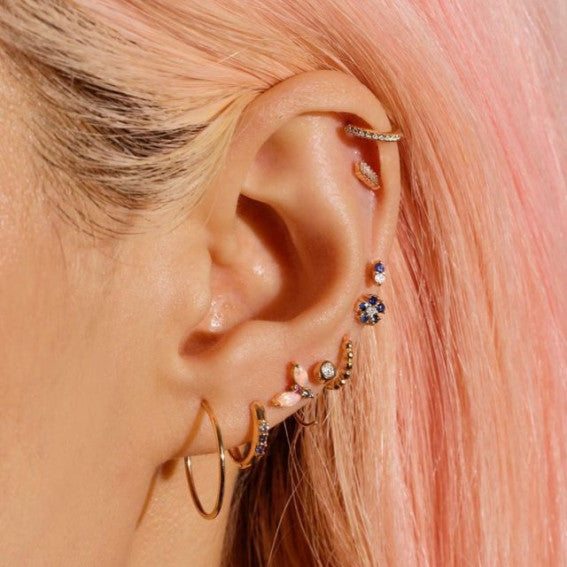
Flat-back labrets are a favourite for helix, forward helix, tragus, conch, flat and lobe piercings. The smooth disc creates a clean profile behind the ear, while the front can be as subtle or statement-making as you like. A tiny gold sphere or clear stone works beautifully for everyday wear; a celestial motif, Gothic-inspired piece or colourful gem can give a curated ear more personality.
They are especially practical for tragus and conch piercings, where a bulky back can press into the ear or make wearing earbuds less comfortable. The right post length is crucial here. Too long, and the jewellery can move around and catch. Too short, and it may put pressure on the piercing.
Lip piercings
For a traditional labret, side labret, medusa or Monroe piercing, a flat disc sits inside the mouth while the decorative end is visible outside. This is usually more comfortable than having a ball against the gum or inner lip.
That does not mean any labret stud is automatically suitable. Lip jewellery needs to be correctly sized by a professional piercer, particularly while swelling is present. Once fully healed, downsizing to a shorter post can improve both comfort and the way the jewellery sits.
The everyday comfort factor
If you sleep on the pierced side, wear over-ear headphones or regularly style your hair around your ears, a flat back can be a game-changer. It is less likely to dig in than a ball-ended barbell, though no jewellery is completely snag-proof. Fine chains, chunky jumpers and towels can still catch on decorative fronts.
When a straight barbell is the better choice
Straight barbells have their own place, and for some piercings they are the more appropriate design. Their two-ended shape is practical when both sides of the piercing are visible or need equal clearance.
Nipple and tongue piercings
Straight barbells are the classic choice for nipple piercings. Both ends sit externally, allowing the jewellery to rest evenly across the tissue. The bar needs to match your individual anatomy, with enough length to avoid pressure but not so much that it shifts excessively.
For tongue piercings, straight barbells are also standard. Initial jewellery is longer to account for swelling, then changed to a shorter bar once your piercer confirms it is safe. A bar that is too long after healing can knock against teeth more often, while a bar that is too short can feel tight and uncomfortable.
Certain ear placements
A straight barbell can work in some cartilage piercings, depending on angle and anatomy. It is not normally the first style people choose for a polished, low-profile ear stack, but it can create a deliberate industrial or alternative look. If both ends are on show, matching balls, spikes or gem ends add balanced detail.
Be cautious about using a straight barbell where a flat-back labret would sit more naturally. A barbell’s rear ball can press into the curves of the ear, particularly in a tragus or conch. What looks great in a product image may not be the most comfortable choice for your particular placement.
Comfort, fit and healing are not the same thing
The prettiest jewellery is never the right choice if it is the wrong fit. A fresh piercing may require a longer post or bar to allow for swelling, while a healed piercing often needs a shorter, closer-fitting piece. This is why jewellery that felt fine on day one can start to feel clumsy a few weeks later.
It is also worth separating initial piercing jewellery from the pieces you wear once healed. A professional piercer will generally select jewellery based on body-safe material, finish, threading and appropriate sizing for the piercing process. After healing, you have much more freedom to choose elevated sterling silver and 18k gold designs that suit your wardrobe and your collection.
If a piece feels tight, repeatedly embeds, causes persistent soreness or leaves a deep indentation, do not simply force it to work. Ask a reputable piercer to assess the fit. Likewise, a post that keeps spinning, catching or hanging forward may be too long.
Threading matters as much as the shape
When comparing labret studs and barbells, look beyond the silhouette. How the ends attach affects comfort, quality and how easy the jewellery is to wear.
Internally threaded jewellery has a smooth post end, with the thread set inside the jewellery. The decorative top screws into it. This can be gentler when jewellery is inserted through a healed piercing because no external thread passes through the channel.
Threadless jewellery uses a bendable pin that pushes into the post. It is secure when fitted properly and makes changing decorative tops refreshingly simple. This is particularly handy for flat-back labrets, where you may want to switch from a simple stud to a stone, charm or seasonal design without replacing the whole post.
Externally threaded pieces have the screw thread on the post itself. They are common, but the thread can feel less smooth during insertion. Whatever style you choose, do not overtighten ends. Jewellery should be secure, not impossible to remove.
Choosing materials that look good and wear well
Material affects more than colour. It can influence how comfortable jewellery feels in long-term wear, especially if your skin is sensitive. For a newer piercing, follow your piercer’s recommendation on materials and timing. For established piercings, quality sterling silver and 18k gold jewellery bring a more elevated finish to an ear stack or everyday look.
Silver gives a cool, versatile tone that works beautifully with clear stones, black detailing and Gothic-inspired styling. Gold brings warmth and is ideal for building a cohesive lobe and cartilage combination. If you wear several pieces, you do not need every item to match perfectly, but repeating one metal tone or one accent colour makes the overall look feel intentional.
Choose a decorative end that suits your routine, too. A large cluster may be perfect for a special event, while a low-profile bezel-set stone is easier for sleeping, gym sessions and busy days. Style should still feel wearable.
A simple way to decide
Choose a labret stud when you want a smooth back, a refined ear or lip look, and plenty of options for changing the visible top. Choose a straight barbell when both ends need to sit externally, as with most nipple and tongue piercings, or when you prefer a more balanced barbell aesthetic.
For any piercing where you are unsure, placement should lead the decision. A piece that suits a helix may not suit a tragus, and jewellery that looks great in a healed lobe may be unsuitable for a fresh cartilage piercing. Professional advice is always more valuable than guessing from a photo.
The best jewellery is the piece you can wear comfortably, confidently and often. Start with the shape that respects your piercing, then let the stones, metal and details make it unmistakably yours.